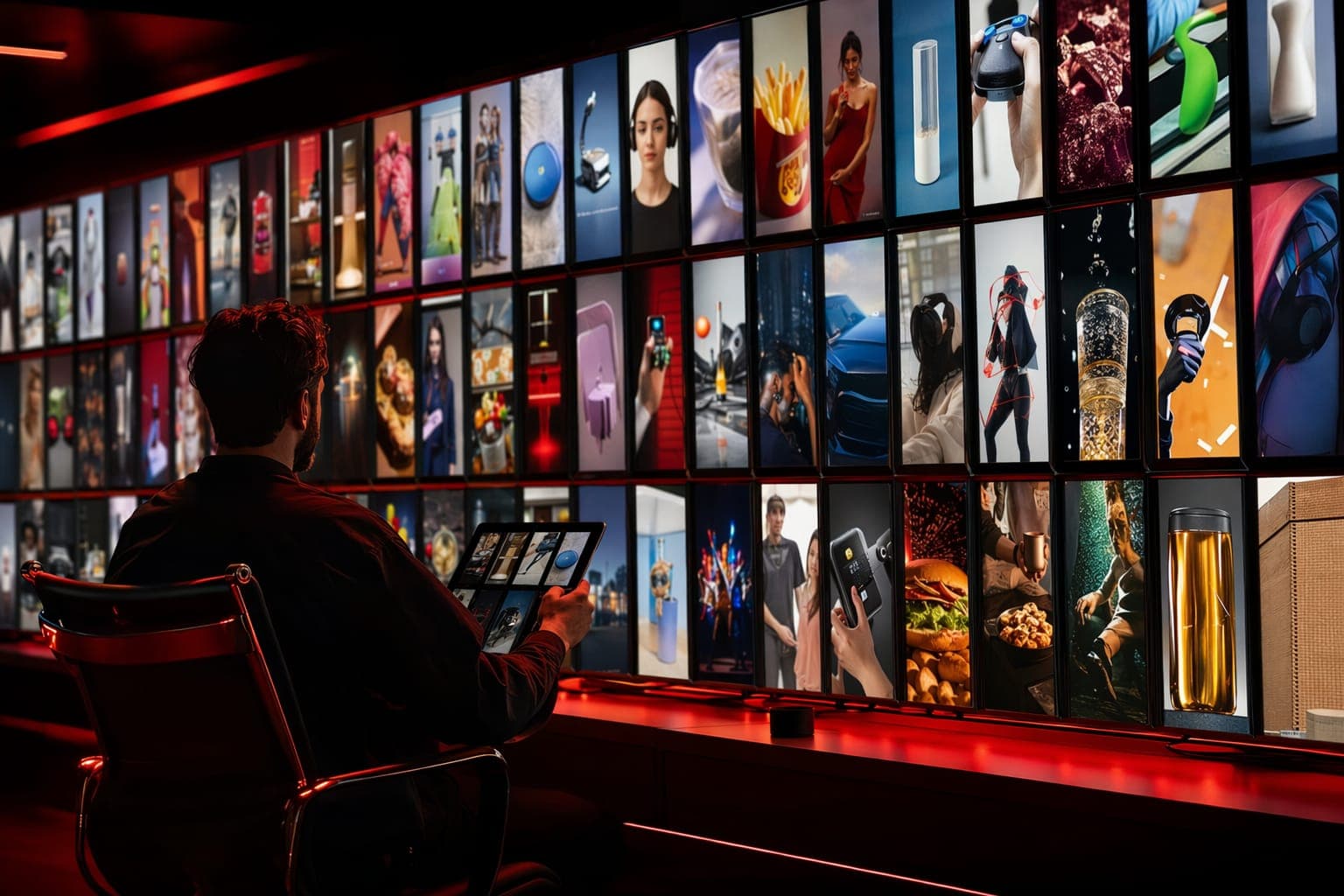
The question every consumer brand asks eventually is not whether to make more short-form video. It is why fifteen clips a month costs what it costs, and why asking for fifty produces a quote that scales linearly when nothing about the work feels like it should.
That linearity is the whole story. A UGC shop prices per clip because a clip consumes a human — a creator, a shoot slot, an editor, a round of revisions. Double the clips, double the humans, double the invoice. There is no version of that model where volume gets cheaper, which is why most brands hit a content ceiling at roughly the point their agency's capacity ends.
We built the Content Engine because we hit that ceiling on our own brands first. It produces 100 reels a week at roughly $0.30 a finished clip, against $80–200 for the same clip made the industry way. This piece lays out where that gap actually comes from, what it does not buy you, and how to decide which model your brand should be running.
Why a UGC clip costs $80–200
Break a single agency-produced clip into its inputs and the price stops being mysterious. There is a creator fee or a shoot slot. There is scripting, usually a round of it. There is an editor's hours. There is a revision cycle, sometimes two. There is account management time spent briefing, chasing and re-briefing. And there is margin over all of it, because somebody is carrying the risk of the creator not delivering.
None of those inputs are padding. They are what it genuinely costs to have people make a video to a brief. The problem is not that the price is unfair — it is that the cost structure is almost entirely labour, so it cannot fall as you order more. A hundred clips is a hundred times the human time, minus a small discount on briefing overhead you amortise.
The second cost is invisible and larger: latency. A UGC shop's turnaround is measured in weeks because it has to be. Brief, cast, contract, ship product, shoot, edit, revise, deliver. By the time a clip lands, the format you spotted three weeks ago has been copied across your whole category. You are paying premium rates for content that arrives after the moment it was designed for.
- Creator fee or shoot slot — the largest single line, and irreducible per clip.
- Scripting, editing and one to two revision rounds, all billed as human hours.
- Account management overhead on briefing, chasing and re-briefing.
- Weeks of turnaround, which is a real cost even when nobody itemises it.
Where the $0.30 figure comes from
Our per-clip cost is roughly $0.30 because we own the pipeline instead of renting it. Three things drive it. First, a persistent Brand Brain holds your voice, product truths, offers, legal do-nots and best-performing references, which removes the briefing and revision loop that eats most of the human hours in the traditional model. Output number 400 sounds exactly like output number one, because nobody re-explains the brand to a new editor.
Second, a single router across 420+ models picks the right model per shot, per format, per budget. Image, video, voice and edit models change every few weeks, and buying compute at the cheapest capable tier for each individual shot is a materially different cost base from standardising on one expensive tool. You get whatever is currently best without rebuilding a workflow every quarter.
Third, the edit is programmatic. Hooks, captions, aspect ratios and thumbnail variants are generated rather than hand-assembled, so producing eight versions of a winning clip costs almost nothing more than producing one. That is where the compounding sits — not in making the first clip cheaply, but in making the forty derivatives of the clip that worked.
What the $0.30 does not include, and we are direct about this: a human editor approves every clip before it publishes. That approval labour is real and it is priced into the retainer. The $0.30 is the production cost of the asset itself, which is exactly the thing the $80–200 comparison measures against.
The comparison, line by line
Set the two models side by side at the volume a serious consumer brand actually needs — call it a hundred clips a month across formats — and the difference stops being a percentage and becomes a change in what is possible at all.
The honest framing is not that one model is better. They are priced for different jobs. A UGC shop is buying you a specific human's face, voice and audience credibility. An AI production pipeline is buying you volume, iteration speed and format coverage. Brands that treat them as substitutes make bad decisions in both directions.
- Per finished clip: roughly $0.30 through the Content Engine, against $80–200 the industry way.
- Weekly output: 100 reels a week sustained, versus a capacity ceiling set by creator and editor availability.
- Turnaround on a winner: variants cloned inside 48 hours, versus a fresh brief-to-delivery cycle in weeks.
- Consistency: enforced by the Brand Brain, versus re-briefed per creator and per editor.
- Format coverage: every aspect ratio and placement generated from one source, versus reshoots or crops.
- What UGC still owns: a real person's face and audience credibility, which no pipeline manufactures honestly.
Where UGC shops still win
We run an Influencer & UGC Engine alongside the Content Engine precisely because creator content is not replaceable. When the persuasion depends on a specific person being trusted by a specific audience, you need that person. No amount of production volume substitutes for a creator whose followers already buy your category — and we shortlist on audience overlap and past conversion behaviour rather than follower count for exactly that reason.
Hero product photography and founder footage are the same story. AI does volume; a studio does hero. That is why our content retainers include studio days — product, tabletop and founder shoots — which then get cut into hundreds of derivative assets by the engine. The mistake is not hiring a photographer. The mistake is hiring one twenty times a year to produce feed filler.
The model that actually works is a loop rather than a choice. Creator assets and studio footage go into the Content Engine and come back out as ad variants, organic reels and screen creative. One campaign fee becomes a quarter of usable content instead of a fortnight of feed. It is also why we buy usage rights up front in every creator contract — typically twelve months of paid and organic usage. That clause is what makes the loop legal, and it is the one most brands forget until they need it.
How to decide which model you need
Start with your actual publishing cadence, not your aspiration. If your channels genuinely consume twelve clips a month and always will, a UGC shop at agency rates is a perfectly rational purchase and a production pipeline is over-engineering. The economics only invert at volume, and volume only matters if you have somewhere to put it.
If you are running daily short-form across two or more platforms, testing hooks in batches, and feeding paid creative from the same library, the linear-cost model becomes the binding constraint on growth rather than a line on the P&L. At that point the question is no longer what a clip costs — it is how fast you can clone the one that worked before it cools.
For reference on what that buys: the Content Engine starts at $2,500 a month standalone, and the Growth tier at $7,500 a month bundles 100 reels a month plus a photoshoot day with WhatsApp journeys and outreach, because content with nothing catching the demand it creates is an expensive hobby. Whichever way you go, the number to interrogate in any content quote is not the monthly fee. It is what happens to the fee when you ask for triple the output.
Questions we get asked
How much does a UGC agency cost in India?
Priced per clip, most UGC work lands in the $80–200 band for a finished, revised short-form asset, and it scales close to linearly because the cost structure is almost entirely human labour — creator fee, scripting, editing, revisions and account management. The figure worth asking any UGC shop for is not their monthly minimum but their quote at triple your current volume, because that is where the model's ceiling shows up.
Can AI content production replace a UGC agency?
It replaces the volume half, not the credibility half. An AI pipeline produces 100 reels a week at roughly $0.30 a clip and clones winners into variants inside 48 hours, which no human shop matches on cost or speed. What it does not manufacture is a specific creator's face and audience trust, which is why we run a creator roster alongside the engine and feed everything the creators make back into it.
Does high-volume AI content just look like AI slop?
That is the real failure mode, and it is what the Brand Brain exists to prevent. Volume without guardrails produces slop; volume inside a persistent brand system, cut from real studio footage, with a human editor approving every publish, produces a feed that looks staffed by a ten-person studio. The way to settle it is a five-clip pilot on your own brand before committing to anything.
Systems behind this playbook
Want to see the pipeline run on your brand before you commit? Ask us for a five-clip pilot and judge the output, not the pitch.
Book a demo